
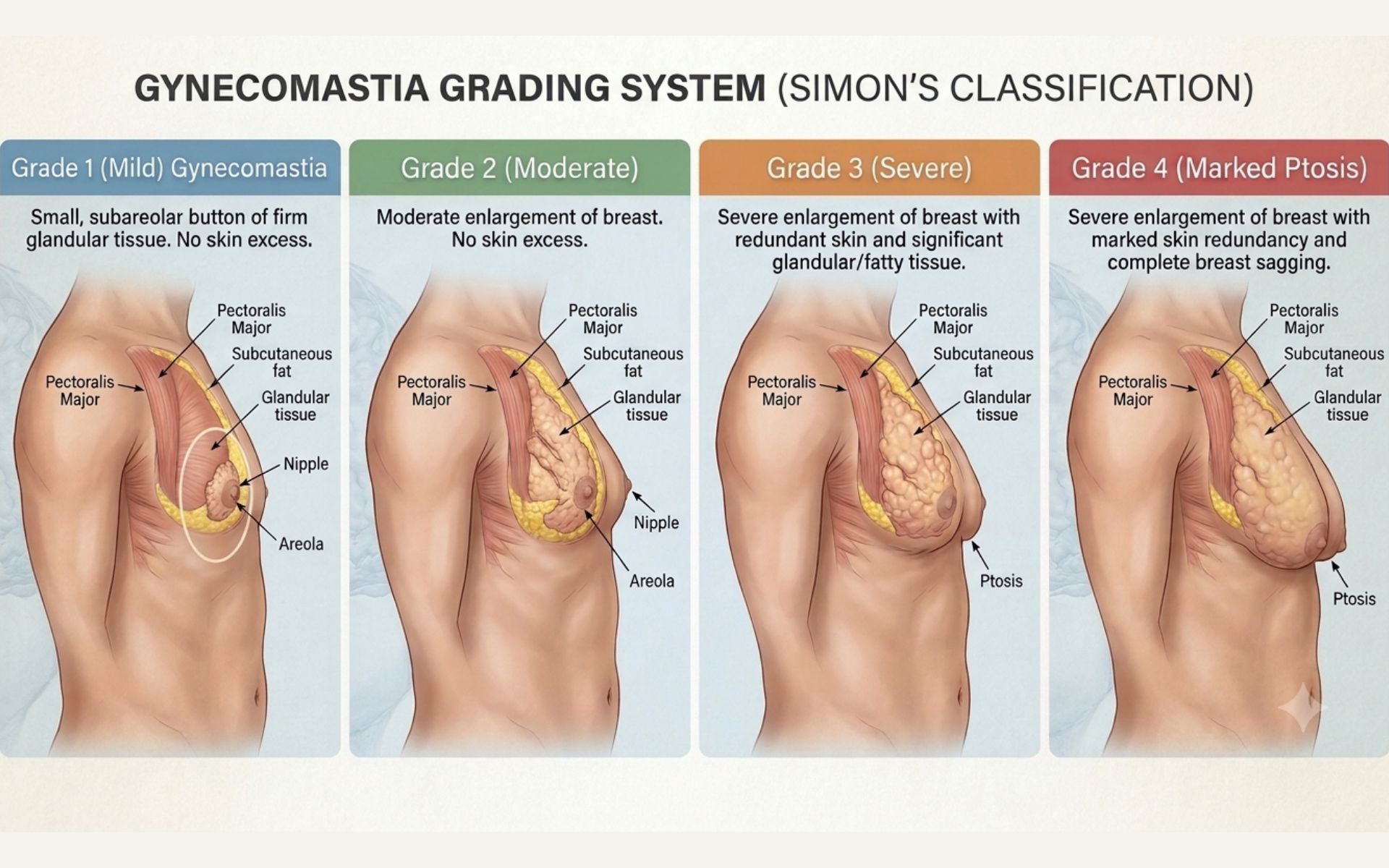
Gynecomastia Grading System: How Severity Decides Your Surgery
Gynecomastia enlargement of male breast tissue varies significantly in severity from patient to patient. Surgeons use a grading system to determine the most appropriate surgical approach, which is why understanding your grade is a useful first step before consultation.
The Simon Grading System:
• Grade I: Small enlargement, no excess skin
• Grade IIA: Moderate enlargement, no excess skin
• Grade IIB: Moderate enlargement with mild excess skin
• Grade III: Marked enlargement with significant excess skin, resembling a female breast contour
Benefits of Grade Based Treatment Planning:
• Right-sized intervention: Avoiding overtreatment for mild cases and undertreatment for advanced ones
• Better prediction of scarring: Lower grades often need only liposuction with minimal or no scarring
• More accurate recovery expectations: Set before surgery
• Combined approach when needed: Glandular excision plus liposuction for firmer tissue with fat component
• Skin excision planning: For higher grades, avoiding a loose or sagging chest post-surgery
How Grade Determines Technique:
Grade I and IIA cases are often managed with liposuction alone or combined with minimal glandular excision. Grade IIB typically requires a combination of liposuction and surgical excision of glandular tissue. Grade III often requires skin excision alongside tissue removal to prevent residual sagging, since skin elasticity alone is insufficient to redrape over the newly reduced chest.
What Causes Gynecomastia?
Common contributing factors include hormonal imbalance, certain medications, anabolic steroid use, obesity, and some underlying medical conditions. A medical evaluation is often recommended before surgery to rule out treatable underlying causes, particularly in cases of sudden or recent onset.
Recovery Timeline:
• Week 1: Swelling, bruising, and compression garment use begins
• Weeks 2–3: Return to non-strenuous work and daily activity
• Weeks 4–6: Return to exercise, particularly upper body workouts
• Months 3–6: Final chest contour visible as swelling fully resolves
Frequently Asked Questions:
Can gynecomastia be treated with liposuction alone?
Only in milder grades where the enlargement is primarily fatty tissue without significant glandular component or excess skin.
Does higher-grade gynecomastia mean more visible scarring?
Grade III cases often require skin excision, which does involve more scarring compared to liposuction-only approaches for milder grades.
Can gynecomastia recur after surgery?
Recurrence is uncommon when the underlying glandular tissue is adequately removed, though hormonal or medication-related causes should be addressed to prevent regrowth.
Is gynecomastia surgery covered by insurance in India?
This varies by insurer and is typically assessed case-by-case, generally depending on whether it’s classified as reconstructive versus cosmetic.
Should I get blood tests before gynecomastia surgery?
Many surgeons recommend hormonal evaluation, particularly for sudden-onset cases or younger patients, to rule out an underlying treatable cause.
How do I know which grade I have?
This is determined through a physical examination during consultation, assessing the degree of glandular enlargement and any excess skin present.

Post a comment