
Combining Rhinoplasty and Chin Augmentation: Is It Safe in One Surgery?
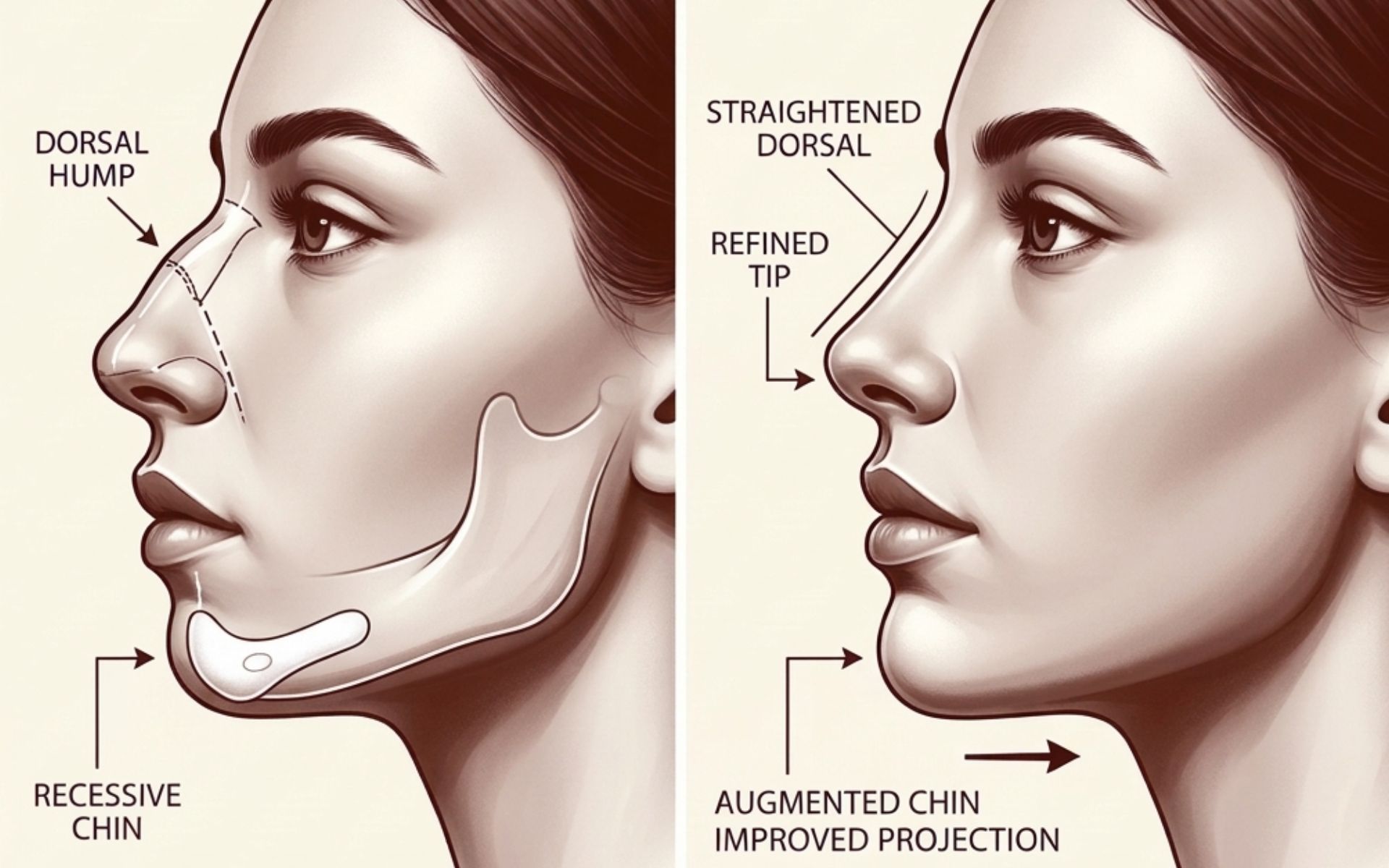
Facial harmony is often about proportion and balance between features, not any single feature in isolation. This is why some patients considering rhinoplasty are also advised to evaluate chin projection, since combining both procedures can achieve more balanced results than addressing the nose alone.
Why the Nose and Chin Are Often Considered Together:
A receding chin can make the nose appear more prominent than it actually is, and correcting the nose alone in such cases may not achieve the desired facial balance. Combining rhinoplasty with chin augmentation addresses the profile as a whole.
Benefits of Combining Both Procedures:
• Improved overall facial harmony by addressing profile balance rather than a single feature
• Single anesthesia and recovery period instead of undergoing two separate surgeries and recovery timelines
• Cost efficiency compared to two separate procedures at different times
• More predictable final aesthetic outcome, since both features are planned and assessed together
Safety Considerations:
When performed by an experienced surgeon, combining these procedures is generally considered safe, provided the patient is medically fit for a slightly longer surgical and anesthesia duration. Careful pre-operative planning, including imaging and profile analysis, helps ensure balanced, proportionate results.
Is Combined Surgery Right for You?
• You have both a nasal concern and a receding or weak chin affecting profile balance
• You are in good general health and medically fit for a combined procedure
• You prefer a single recovery period over two separate surgical experiences
• Your surgeon has confirmed, through profile analysis, that both areas would benefit from correction
Recovery Timeline:
• Week 1: Swelling at both surgical sites, splint on nose, possible chin swelling
• Weeks 2–3: Most visible bruising resolves
• Weeks 4–6: Return to normal activity and exercise
• Months 6–12: Final combined result visible as nasal swelling fully resolves
Frequently Asked Questions:
Does combining these surgeries increase recovery time?
Recovery is generally similar to undergoing rhinoplasty alone, since chin augmentation typically has a shorter, more comfortable recovery period.
Is chin augmentation done with an implant or by reshaping bone?
Both approaches exist implant-based augmentation is more common for straightforward cases, while bone-based techniques (sliding genioplasty) may be used for more significant corrections.
How do surgeons decide if I need both procedures?
This is typically assessed through facial profile analysis and photographic evaluation during consultation, examining the relationship between nose, chin, and overall facial balance.
Can I have chin augmentation without rhinoplasty if that’s my only concern?
Yes, chin augmentation can absolutely be performed as a standalone procedure when the nose does not require correction.
Is anesthesia time significantly longer for combined surgery?
It is somewhat longer than a single procedure, but generally still within a safe, standard timeframe for healthy, well-screened patients.
Will combining the procedures affect the final cost?
Combined procedures are often more cost-effective than two separate surgeries, since facility and anesthesia fees are shared across a single session.

Post a comment