
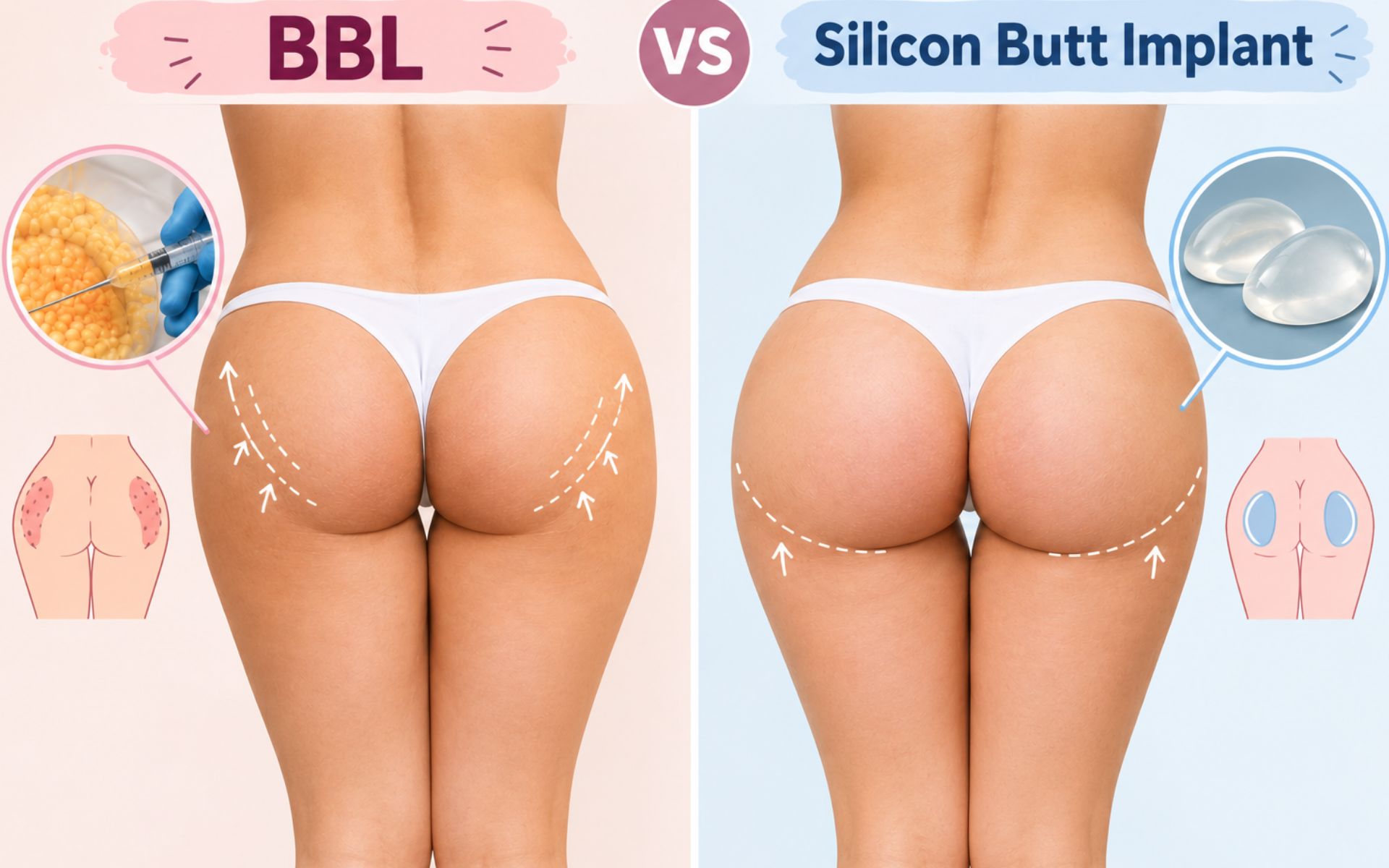
BBL (Fat Transfer) vs Silicone Butt Implants: Which Is Safer?
Buttock augmentation has grown significantly in popularity, and patients typically choose between two approaches: fat transfer (often called a Brazilian Butt Lift, or BBL) and silicone Butt implants. Each has a distinct safety profile, recovery process, and ideal candidate.
Fat Transfer (BBL):
This technique involves liposuction from donor areas such as the abdomen or thighs, followed by purification and injection of fat into the buttocks. It offers a dual benefit of body contouring plus augmentation using the patient’s own tissue.
Silicone Butt Implants:
Silicone implants are placed either within or beneath the gluteal muscle, offering a more predictable, permanent volume increase, particularly useful for patients with insufficient donor fat for a fat transfer.
Benefits Compared:
Fat Transfer Benefits : Uses the patient’s own tissue, avoiding implant-related risks like rupture Simultaneously contours the donor liposuction area More natural look and feel in appropriately selected patients No risk of implant displacement or capsular contracture
Silicone Implant Benefits: Suitable for patients with low body fat and insufficient donor supply More predictable, consistent long-term volume (fat transfer has some natural reabsorption) No dependency on maintaining stable body weight for results to last
Safety Considerations:
Fat transfer carries a well-documented risk when fat is injected too deep, near or into the gluteal muscle, which can lead to fat embolism a rare but serious complication. This is why injection technique and depth control are critical safety factors, and should only be performed by surgeons trained in safe BBL protocols. Implant surgery carries its own risks, including infection, implant malposition, and capsular contracture.
Which Option Suits You Better?
• Choose fat transfer if: You have adequate donor fat, want simultaneous body contouring, and prefer using your own tissue
• Choose implants if: You are lean with limited donor fat, want more predictable permanent volume, and are comfortable with implant-related surgical considerations
Recovery Timeline:
Fat Transfer (BBL): Limited sitting for 2 weeks, compression garment for 4–6 weeks, final results visible around 3–6 months once remaining fat has stabilised.
Silicone Implants: Limited sitting for 2–3 weeks, avoid strenuous exercise for 6 weeks, final results visible around 2–3 months as swelling resolves.
Frequently Asked Questions:
Which technique has a lower risk of serious complications?
When performed with strict adherence to safe injection depth protocols, fat transfer has a good safety record; implant surgery carries more standard surgical risks like infection and implant-related complications.
How much fat survives after a BBL?
Typically 60–80% of transferred fat survives long-term, which is why slight overcorrection is often planned during surgery.
Can implants and fat transfer be combined?
In select cases, yes implants can provide a base structure with fat transfer used to refine contour and smoothness.
Is one technique more permanent than the other?
Silicone implants generally offer more permanent volume, while fat transfer results can be influenced by future weight changes.
Can I sit normally after either procedure?
Both procedures require restricted or modified sitting for a period of time, generally longer with fat transfer to protect the transferred fat cells’ blood supply.
Which technique has a more natural feel?
Fat transfer, using the patient’s own tissue, is generally considered to feel more natural, though well-placed implants can also achieve a very natural result.

Post a comment